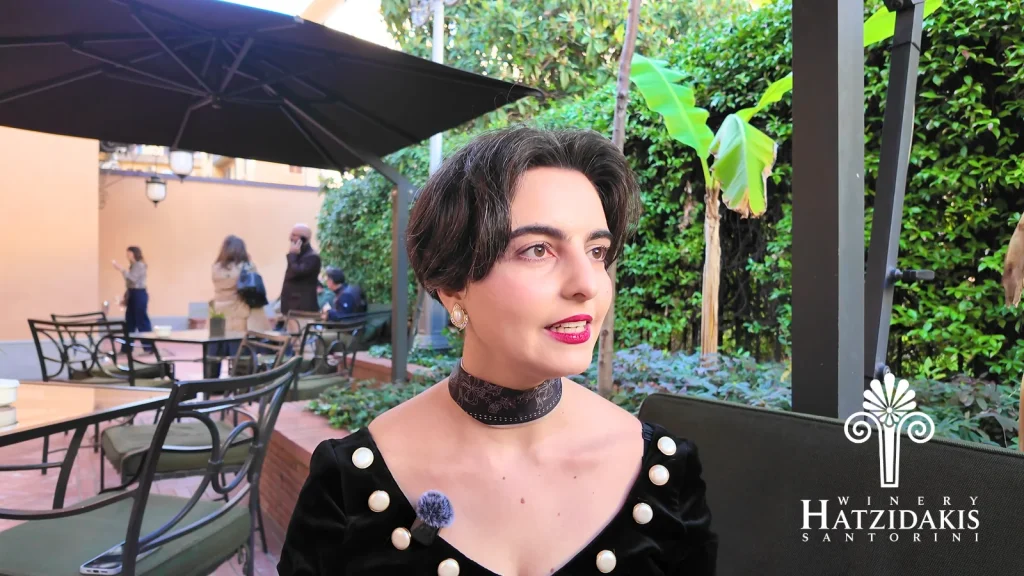
At Greek Wine Day in Florence, I meet Stella Hatzidakis again, a second-generation member of one of Santorini’s most respected wineries. What begins as a tasting of her family’s wines becomes a conversation about memory, identity and passion, revealing an unexpected connection between winemaking and opera.
Among the tasting stands at Greek Wine Day in Florence, surrounded by the familiar mix of voices, clinking glasses and stories that fills the room each year, I find myself looking for a familiar face. There is Stella Hatzidakis, standing behind her family’s wines, ready once again to share a little of her Santorini. We recognise each other and exchange a smile. A year has passed since we first met, at this very event, during my first Greek Wine Day, when the wines of Hatzidakis Winery won me over with their remarkable elegance, precision and ability to express the character of the island.
We have kept in touch since then, but this time, as well as tasting her wines again, I want to understand more about the story behind them and, above all, the woman helping to keep that story alive. I ask whether she would like to have a chat for Wining.it, little knowing that our conversation is about to take such a personal and fascinating turn.
To understand Stella’s connection with her homeland, we need to go back to 1997, when her parents, Haridimos Hatzidakis and Konstantina Chrysou, both of whom had worked at Boutari Winery on Santorini, decided to establish an independent venture that would eventually become one of the island’s leading names in wine.
It all began in Pyrgos Kallistis, with a vineyard belonging to Konstantina’s family. Situated at approximately 330 metres above sea level, it had lain abandoned since 1956. Beside the old vines stood a small cave, which, with limited resources and a great deal of hard work, they converted into a kanavaki, the name Santorini islanders give to their traditional small family wineries. From these modest beginnings emerged what was then a pioneering approach to winemaking: restoring the island’s viticultural heritage through organic farming, championing indigenous grape varieties and allowing the land, rather than the winemaker’s intervention, to shape the character of the wine.
This philosophy makes particular sense on Santorini, where growing vines has meant finding ways to live with an environment as beautiful as it is unforgiving. The island’s sandy volcanic soils have preserved an extraordinary heritage of ungrafted vines, many more than a century old. Meanwhile, the Aegean winds, scarce rainfall and intense sunlight have given rise to distinctive training methods, including the traditional kouloura, in which the vine shoots are woven into a basket-like shape to protect the grapes from the harshest weather.
It was in this landscape that Haridimos developed his vision, based on certified organic viticulture, fermentation with indigenous yeasts, minimal intervention in the cellar and bottling without filtration. The same philosophy extends to the underground winery, carved into the volcanic rock, where naturally stable temperatures and humidity provide favourable conditions for the wines to mature.
“Good wine is made in the cellar, great wine is made in the vineyard,” Haridimos liked to say.
A seemingly simple principle, yet one that expresses his belief that wine cannot be separated from the land, the people who work it and the work itself.
Following the founder’s untimely death in 2017, that vision passed to his three children, Stella, Antonis and Ariadne Hatzidakis. Today, together with a young team, they face the demanding but rewarding task of carrying on their father’s legacy while allowing it to evolve.
And it is when we begin talking about her father that I glimpse another side of Stella, beyond her professional role.
Her voice, so lively until now as she described the wines, softens, and I sense an emotion she is trying to hold back. She tells me how working at the winery helps her feel close to him, allowing her to continue something that mattered deeply to both her parents and remains present in the decisions she makes every day. Her words come naturally, although at moments her voice catches slightly. Stella smiles, without trying to conceal her quiet, genuine emotion, and I find myself thinking how demanding, yet extraordinarily beautiful, it must be to inherit something of such personal significance.
For her, making wine is not simply a matter of continuing the family business. It is a way of preserving a bond, of recognising in everyday gestures the presence of those who taught her to love this land, and of finding her own way to carry their story forward.
One wine, perhaps more than any other, seems to embody what Stella has been telling me: Santorini Familia PDO, made entirely from Assyrtiko grown in the vineyards of Pyrgos.
Its history is closely intertwined with that of the family. After Haridimos’s death, several growers who had worked with the winery for many years chose to stand by his children and help them continue the project. In 2018, the wine, previously known simply as Santorini, was renamed Familia in honour of those people, who had come to be regarded as part of the Hatzidakis family.
It was a tribute to the strength of human relationships, giving the word “family” a broader meaning, one that also embraces trust, shared commitment and a sense of belonging.
In the glass, Familia displays the same precision that impressed me a year ago. Bright straw-yellow in colour, it opens with elegant notes of lemon, lime and white flowers, followed by hints of flint and a saline edge. On the palate, it is taut and focused, with vibrant acidity supporting a deep savoury quality that sits in perfect balance with the wine’s structure. The long, citrus-driven finish leaves a lingering mineral impression, evoking the island’s volcanic landscape and proximity to the sea. An exceptionally well-defined Assyrtiko, combining intensity and elegance without losing its immediacy.
Quite different in character, though equally expressive of its origins, is Nykteri PDO Santorini, also made entirely from Assyrtiko, this time from the old vineyards of Megalochori. Its name recalls the ancient practice of harvesting and making wine at night to protect the grapes from high temperatures. Hatzidakis offers an interpretation that draws on riper fruit and twelve months of ageing in French oak.
The wine is a luminous gold, almost reminiscent of the island’s sunshine. Aromas of peach and ripe apricot emerge alongside candied orange peel, delicate hints of honey, chamomile and sweet spices. The palate is broad, rich and enveloping, yet a firm line of acidity runs through it, supporting the structure and preventing the wine from feeling heavy. A saline character persists throughout, leading to a long, layered finish with a pronounced mineral quality.
These are two very different expressions of Assyrtiko, demonstrating the grape’s versatility and, above all, Hatzidakis’s ability to preserve its identity even when exploring more complex styles of winemaking.
As the tasting continues, our conversation turns to another side of Stella’s life that particularly interests me. Alongside wine, she has a deep love of opera. Stella is a soprano, and her artistic sensibility is very much part of her life at the winery, creating an ongoing dialogue between two worlds that, at first glance, might seem far apart.
After eighteen years working in the recording industry, music still holds an important place in my life, and finding it again through wine feels almost natural. These are two worlds I know and love deeply, and they have far more in common than one might imagine. Both require knowledge, discipline, technique and sensitivity in interpretation. Above all, both can stir emotions through a language that does not always need explaining. A musical score, like a great wine, can be broken down into its individual elements, studied for its structure and appreciated for its complexity. Yet when it genuinely moves us, all those elements seem to come together in an immediate, deeply personal experience.
Listening to Stella speak about her love of singing, I feel these two worlds, both so important in my own life, coming together once again. And I find myself suggesting a rather unconventional pairing.
What if, instead of pairing wines with food, we paired them with operas?
Stella looks at me and smiles. Her eyes light up instantly, as though the question has opened a door onto something wonderfully familiar. We begin exploring the character of the wines through musical language, looking for connections between structure and rhythm, intensity and lightness, complexity and emotional tension.
Stella’s choices are surprising, but what strikes me most is how deeply she understands the personalities of her wines.
The first wine in this unusual pairing is Mavrotragano PGI Cyclades, made from the rare red grape variety of the same name, which accounts for less than 4% of Santorini’s vineyard area.
Sourced from vineyards in Pyrgos, Megalochori and Akrotiri, the wine spends eighteen months in French oak, followed by another twelve months in bottle. This ageing develops its complexity, bringing out its assertive character without sacrificing finesse.
Bright ruby in colour, it offers an aromatic profile of red berries and woodland fruits, elegant balsamic hints of eucalyptus, spices, dark chocolate and tobacco. On the palate, it is intense and structured, with well-integrated tannins and a freshness that carries through to a persistent finish, where the spice returns alongside a subtle saline note.
Stella pairs it with Pagliacci by Ruggero Leoncavallo.
It is a choice that fascinates me and, the more I consider the character of Mavrotragano, the more fitting it seems.
In this celebrated verismo opera, the illusion of theatrical performance gradually becomes entangled with the reality of human passions, until it is impossible to separate the mask from the man wearing it. The music moves between tension, soaring melodic passages and an ever-growing dramatic intensity that builds towards the final tragedy.
Mavrotragano, too, seems to conceal a deeply passionate nature beneath its composed structure. At first, the tannins give the wine its firm outlines, while the fruit, balsamic notes and spices gradually reveal something warmer and more vibrant.
It is a wine in which strength leaves room for sensitivity and intensity finds its balance. As in music, emotion emerges from contrast.
Our second pairing centres on a wine with particularly deep significance for the Hatzidakis family: Skitali PDO Santorini, made exclusively from Assyrtiko.
Its story begins with the 2016 harvest, when Haridimos decided to set aside some of the Assyrtiko must for a different ageing process. One tank had stood out for the quality of its wine, and he chose to extend its time on the fine lees, recognising its potential to develop further.
After his death, the winemaking team continued to follow the wine’s progress, recognising in this experiment one of Haridimos’s final ideas. The result was Skitali, a Greek word meaning “baton”, the one passed from hand to hand in a relay race.
It is hard to imagine a more meaningful symbol of this family’s continuity.
The wine spends twelve months on its fine lees in stainless steel before further ageing in bottle, developing considerable structure and complexity, with notes of ripe citrus, white flowers, yellow fruit and mineral nuances. The palate is full, enveloping and notably concentrated, but what makes it especially interesting is the way it develops in the mouth. Acidity cuts through the richness, lifts the weight of the wine and gives it an almost unexpected momentum, bringing freshness, balance and a long, savoury finish.
For Stella, this wine evokes La Bohème by Giacomo Puccini. She describes its fullness, a structure that initially seems to assert itself with all its weight before becoming lighter, almost as though following a musical phrase. It is the acidity, she points out, that performs this role in the wine, bringing rhythm and tension to such a substantial body.
As I listen, I think of Puccini’s extraordinary ability to write music in which the intensity of the orchestra suddenly gives way to the delicacy of a melodic line. His compositions move between fullness and lightness, momentum and suspension, without ever breaking the emotional flow.
Skitali seems to follow a similar pattern. Its structure provides the orchestral depth, while the acidity emerges like a vocal line running through the wine, lifting it and carrying it towards a bright, remarkably persistent finish.
Yet the connection with La Bohème also has a more intimate meaning for me, one rooted in the history of the wine and the people who created it. Puccini’s opera tells a story of feelings, relationships, vulnerability and memories whose significance comes from their profoundly human nature. Skitali, too, was born from an idea that others chose to preserve and carry forward, determined not to let it disappear but to give it a new life.
A legacy that does not remain frozen in time, but continues to live through the hands and sensibilities of those who have inherited it.
As our conversation draws to a close, I realise that this second meeting with Stella has left me with something different from the previous year. The wines have once again confirmed the elegance, precision and remarkable identity of a winery I consider among the most interesting on Santorini. This time, however, I have also had the opportunity to understand more of the woman who now speaks about them with such pride.
In Stella, I recognise something that has long been part of my own way of thinking: the belief that wine cannot be reduced to a tasting note, however rigorous and necessary that may be. Wine belongs to a much wider cultural world, shaped by history, art, geography and, above all, people.
On Santorini, old vines have survived for generations, weaving their shoots together to shelter from the wind and sending their roots deep into soil that has never made life easy for them. I like to think that the Hatzidakis family’s story resembles those vines: able to withstand hardship, protect what matters and continue bearing fruit, even after difficult times.
And perhaps, in the end, that is the deepest meaning of Skitali: not simply passing on the baton, but making sure the music continues.