Food, wine and landscape as forces for cultural and social change. At BTO Florence 2026, we met Barbara Nappini, President of Slow Food Italy, to discuss wine tourism, younger generations and food awareness. What emerges is a vision in which the beauty of our landscapes is shaped by agriculture, everyday choices become a collective responsibility, and education provides the foundation for a different future. Underpinning it all is a lesson from Carlin Petrini that continues to guide her: change is possible, and it can be achieved with joy.
Can we really change the world through what we eat and the wine we choose to drink? It might sound like an overly ambitious question, particularly at a time when food is so often discussed in terms of gastronomic trends, restaurant rankings and tourism experiences. Yet behind every food product lies a network of relationships involving agriculture, the environment, the economy, landscapes and communities. Changing our relationship with food therefore means, at least potentially, influencing many of the forces that shape the places where we live.
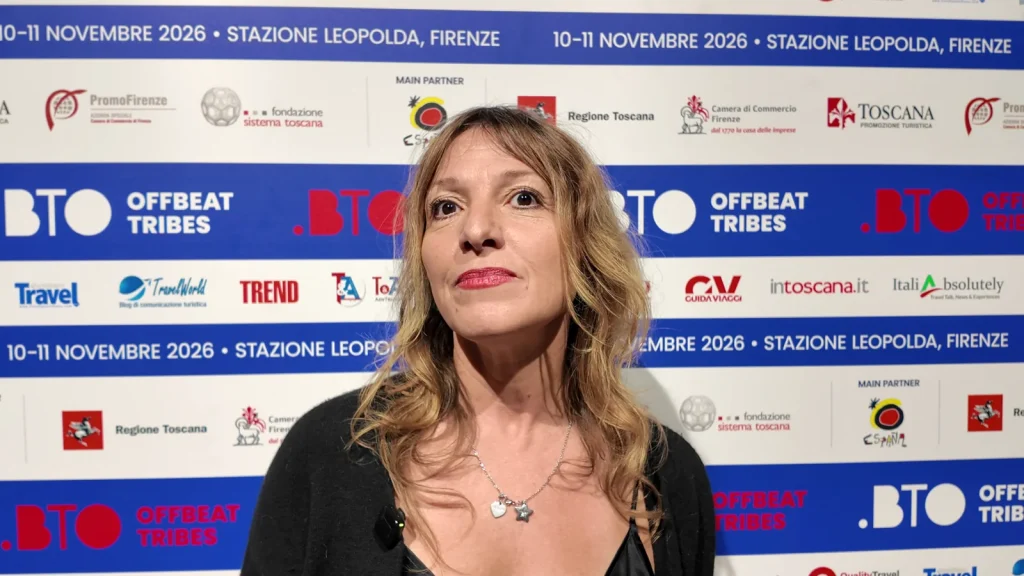
This is where my conversation begins with Barbara Nappini, whom I met at the Stazione Leopolda in Florence during BTO 2026, the event dedicated to innovation and the future of tourism. President of Slow Food Italy since 2021 and the first woman to hold the position, Barbara took part in the session “The Tribe That Had Seen the Future: When Carlin Petrini Imagined a Different Kind of Tourism”, exploring Slow Food’s cultural legacy and its ability to anticipate issues that are now central to the debate on sustainable tourism.
I ask whether food, and wine tourism in particular, can genuinely become instruments of change. Her answer comes without hesitation: “We can certainly change things through food and wine, and we can do it with joy. That’s what Carlin taught me.” She is referring to Carlo Petrini, the founder of Slow Food, whom Barbara remembers not only for his vision of the relationship between food, the environment and society, but also for a less obvious lesson: that working to change things does not mean giving up the pleasure of doing so. It is an idea deeply rooted in the movement’s philosophy, which has never separated food quality from the conditions in which food is produced or the wellbeing of the communities involved.
For Barbara, however, change does not simply come from adding together countless individual initiatives. She makes a point of challenging the reassuring idea that everyone can change the world by doing their own little bit. “I don’t believe in that fairy tale about everyone doing their bit,” she observes, before explaining that genuine transformation occurs when many people begin asking questions, seeking information and taking action, gradually recognising themselves as part of a collective. The difference, then, is not made by isolated gestures, but by developing a shared awareness capable of influencing behaviour and decisions on a much broader scale.
It is an important distinction, particularly when applied to wine. Choosing a bottle, visiting a winery or buying a product from a particular supply chain may seem an entirely personal decision, but it becomes part of something more significant when those choices help support a particular agricultural model, a local economy or a way of managing the land. From this perspective, wine is not simply a drink or something to taste, but a means of understanding the relationship between people and the places they inhabit.
To explain this connection, Barbara turns to a landscape she knows particularly well: Tuscany. “When we think of Tuscany, we immediately picture landscapes with cypress trees, olive groves, vines, hedgerows and woodland,” she says, before introducing an observation that changes the perspective entirely. What we are accustomed to calling beauty, she argues, is actually the result of agricultural complexity, a balance developed over time through the management of crops, natural resources and rural spaces.
It is a point worth considering because it challenges our tendency to regard landscapes as something permanent, almost a natural heritage existing independently of human activity. In reality, many of the views that make our regions instantly recognisable are the result of centuries of agricultural work. Vineyards shape the hillsides, olive groves contribute to their identity, while hedgerows and woodland help maintain the balance of local ecosystems. When these activities are abandoned or managed differently, the landscape changes too, sometimes profoundly.
And this is precisely where the discussion connects with wine tourism. Visitors choosing to explore a wine region are not necessarily looking only for a tasting. They often want to immerse themselves in a setting they perceive as authentic, harmonious and culturally distinctive. That harmony, however, is not accidental: it depends on agricultural practices, producers’ decisions and the ability to maintain a balance between economic activity and the land. In this sense, wine tourism can become a means of celebrating a region, but also an opportunity to help visitors understand the work and knowledge required to preserve the landscapes they admire.
Barbara’s reflections therefore suggest a responsibility shared by producers and those who organise and promote tourism experiences. Telling the story of a place should not simply mean displaying its most picturesque features, but helping visitors understand how they came to exist and how they are changing. A vineyard is not merely a backdrop for a photograph, just as an agricultural landscape cannot be reduced to a decorative feature of a tourism offering. Behind that beauty lie production choices that can either help preserve it or put it at risk.
I then ask what role younger generations can play in change on this scale. Barbara responds with an enthusiasm that reveals just how much the subject matters to her. For years, she observes, we imagined young people becoming increasingly absorbed by screens, with little interest in participation or collective action. Yet she believes that perception has proved mistaken. “We thought young people had been numbed by their screens, but we got that wrong,” she says with a smile, pointing out that while they appeared to be spending hours on digital devices, they were also developing their own ideas, awareness and critical thinking.
Barbara sees young people’s willingness to participate, including through their physical presence at demonstrations, as an important sign. But her enthusiasm also extends to the contribution younger generations are making to agriculture, viticulture and hospitality. Within the Slow Food network, she explains, many young people are involved in projects and initiatives that seek to rethink our relationship with the land and food. She particularly highlights young people and women as two of the most dynamic forces behind this transformation, thanks to their ability to introduce new ideas and challenge established models.
It is a particularly interesting perspective for the wine industry, which is often preoccupied with how to attract younger generations to wine consumption and culture. Barbara’s words suggest looking at the question from another angle: young people are not simply an audience to be won over, but people who can directly contribute to changing how wine is produced, communicated and experienced. Their role extends beyond drinking preferences to the ability to imagine different approaches to agriculture, hospitality and food culture.
Of course, turning this energy into lasting change requires one essential ingredient: knowledge. And it is to food education that we devote the final part of our conversation.
Barbara recalls how Slow Food chose, from the very beginning, to pursue two parallel paths. On the one hand, supporting quality food and wine production; on the other, spreading knowledge and awareness so that more people would be able to recognise that quality and make informed choices. In other words, there is little point in promoting production systems that are more respectful of the environment and people if consumers lack the tools to understand their value.
“Every time we make a purchasing decision, whether it’s food or wine, we’re supporting one type of supply chain rather than another,” Barbara observes. It is a simple point, but one with far-reaching implications, because it gives consumption a meaning beyond taste or price. Choosing a product also means contributing, through demand, to the survival of particular economic activities and agricultural practices. Making those choices consciously, however, requires access to reliable, understandable information.
This is also where the role of those who communicate food and wine becomes important. Barbara recognises how difficult it can be for consumers to know what they are really buying, but she is encouraged by the growing number of people working to bring the stories behind products to light. Rather than simply describing what ends up on our plates or in our glasses, they are beginning to tell us what happens beforehand: the people who grow, raise and process the ingredients, the characteristics of the land, the techniques involved and the decisions that shape the final result.
It is an approach to communication that goes beyond product promotion and gives storytelling a cultural purpose. In the case of wine, for example, it means looking beyond the sensory characteristics of a bottle to understand vineyard work, environmental conditions, agricultural practices and the relationship between a winery and its community. This knowledge does not have to turn everyone into an expert, but it can help people develop greater independence of judgement.
For Nappini, this process should begin long before adulthood. What is needed, she argues, is well-designed education in schools that seriously addresses agriculture, biodiversity and food supply chains, giving children and young people the tools to understand where their food comes from and the consequences of decisions about production and consumption. Not simply an education in gastronomy, then, but an understanding of the relationship between food, the environment and society.
Looking back on my conversation with Barbara Nappini, one idea seems to connect everything we discussed: food and wine can become instruments of change only when we stop seeing them merely as products and begin recognising them as expressions of a wider network of relationships. Relationships between farmers and consumers, between communities and landscapes, and between individual choices and collective responsibilities. It is within this network that quality takes on a broader meaning, while the beauty of the landscape becomes something to understand and protect, rather than simply admire.
Seen from this perspective, wine tourism can also take on a different role. Rather than merely bringing more visitors into wineries or increasing the commercial value of tourism experiences, it can create opportunities for encounters and understanding, allowing visitors to discover the agricultural culture of a region and the work of the people who live there. Tourism that contributes to the vitality of communities without turning places into stage sets designed solely for visitors.
It is certainly an ambitious vision, but Barbara Nappini does not appear to regard it as utopian. Her confidence comes from the experience of a movement that has succeeded in transforming a cultural intuition into an international network of people, producers and communities. And perhaps this is the deeper meaning of the lesson she attributes to Carlo Petrini: change requires not only commitment and awareness, but also the ability to build something together, finding in pleasure and conviviality another reason to take part.
Because food and wine, before being products to choose or experiences to purchase, can bring people together, help them understand one another and inspire different ways of living in the world. And if this transformation can begin around a table, in a vineyard or through a more informed everyday decision, the real difference will come when those choices cease to be purely individual and become part of a shared responsibility.