Japan Inside will explore Japan from the inside, through journeys in search of traditional fermented beverages and spirits to import into Italy. We will talk about travel and Japan beyond the usual tourist routes, religion and traditions, local customs, anime and manga, and food.
All of it (almost) always seen through the lens of alcohol — sake, in Japanese. Which brings us to the point: what exactly is the (notorious) sake? How is it made? We will explore these questions in future articles, alongside other topics ranging from politics and economics to history and religious traditions.
Japan is a country of contradictions, a mystery to us gaijin — foreigners, literally “outside people”. Of course, every country has its own traditions, customs and ways of life, but a Westerner’s first trip to Japan can be quite a culture shock. And it is not just the extraordinary order and cleanliness, or the remarkably quiet train carriages. It is also the ancient temples surrounded by modern buildings, and statues of characters such as Godzilla and Gundam that leave visitors wondering what to make of it all.
This contrast continues to hold a powerful fascination. For the fourth consecutive year, Japan has been voted the world’s most attractive country by American readers of Condé Nast Traveler. The recognition comes as international tourism continues to grow, with Japan welcoming a record 42.7 million foreign visitors in 2025. What particularly captivates travellers is the contrast between traditional culture and modern innovation, combined with Japanese hospitality and an almost utopian sense of safety.
Yet Japan is also a country experiencing population decline: its population has fallen by 2.5%, a loss of more than three million people. Despite this, living and working there remains difficult for foreigners, and the government of Sanae Takaichi has further tightened the rules governing residence permits. No, Japan is not a country like any other.
In 2014, there were 21.3 million registered dogs and cats, compared with 16.5 million children under the age of 15. There was also one vending machine for every 23 people.
Then there is “cancel culture” — 取消文化 — which has nothing to do with social media controversies, but instead refers to an increasingly widespread trend among Gen Z: cancelling meals. According to The Japan Times and AERA, many young people skip dinner or even give up cooking and bathing, preferring to devote their time to hobbies and socialising. One extreme example is a 23-year-old woman who eats only once every two days, explaining that “vegetables and meat are too expensive”.
This seemingly bizarre habit is a symptom of a deeper malaise. The IMF forecasts that by 2027 Japan’s nominal GDP will slip from fourth to sixth place globally, overtaken by India and the United Kingdom. Economic stagnation, the weak yen and rising prices are eroding household purchasing power. Among young people, this form of “cancel culture” is, in reality, a quiet way of adapting to an uncertain economic future. Meanwhile, public debt has exceeded 240% of GDP, the highest level among advanced economies.
Japan in 2026 is a country struggling to reconcile its achievements with its contradictions, openness with isolation, and innovation with stagnation. This is precisely what Japan Inside aims to explore: the inner workings of a complex, fascinating society in constant motion.
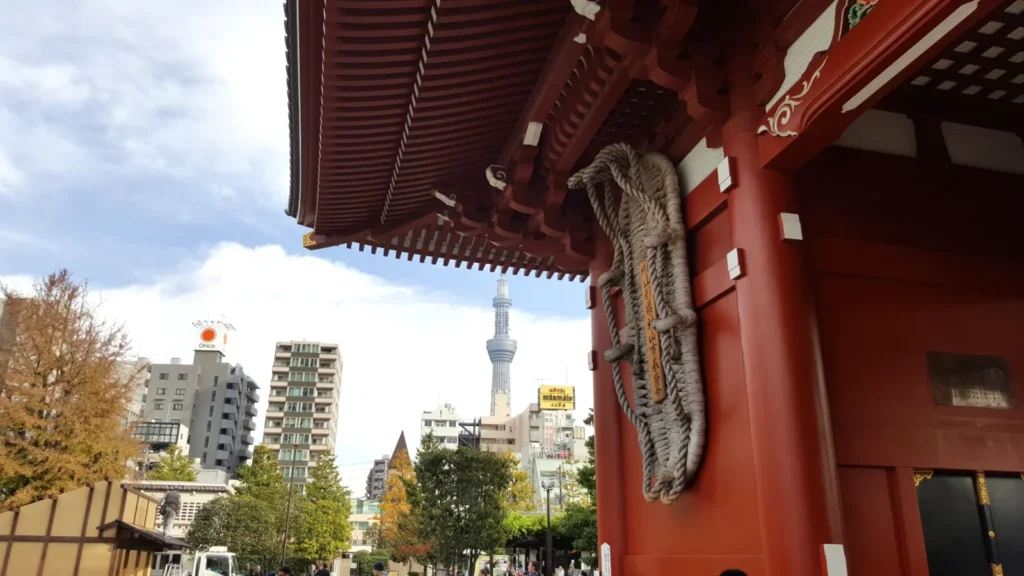
in the Photo:
Tempio Sensō-Ji, Asakusa, Tokyo.
Porta Hōzōmon, sullo sfondo la Skytree di Tokyo.
Visibili appesi degli enormi sandali di paglia di riso (waraji), realizzati tradizionalmente dagli abitanti del villaggio di Murayama.